Moon phases and lunar timing
What Moon Phase Was I Born Under? How to Use Any Calculator (and Trust the Result)
A clear, step‑by‑step guide to using any ‘what moon phase was I born under’ calculator, checking the result, and avoiding the mistakes that throw off your phase.
You might first meet your birth Moon phase through a viral quiz or soulmate test. You type your birthday into a box, get a pretty image, and then wonder: Can I trust this? And if two tools disagree, which one is right?
Here is a clear, tool‑agnostic way to answer “What Moon phase was I born under?” using any calculator, and to sanity‑check the result so you are not building meaning on a shaky calculation.
Step 1: Collect the details that really matter
You can get a rough Moon phase from your date of birth alone, and several tools do exactly that. For instance, the Birth Moon Phase Calculator — Discover Your Lunar Personality only asks for your birth date and then shows the phase.
If you want a result you can trust more, gather three things before you open any calculator:
- Date of birth – day, month, year.
- Place of birth – city and country (for time zone and daylight‑saving handling).
- Exact birth time – as close as you can get from a birth record.
Why this matters:
- The Moon moves quickly. It changes sign roughly every 2–3 days and the illumination changes all day long, so a noon‑only approximation may be slightly off.
- Some tools (like Find the moon phase when you were born) explicitly say they use local noon for the calculation. That is usually fine for getting the phase family (New, First Quarter, Full, etc.), but if you were born very close to a phase change, the exact boundary can wobble.
Treat birth time and place as accuracy upgrades. If you do not have the exact time, you can still use this guide; you will just lean more on cross‑checking in later steps.
Step 2: Run your details through one calculator
Pick a single calculator and get a baseline result.
Any of these styles of tool can work:
- A simple phase finder that uses date only and returns a named phase plus image, like the Birth Moon Phase Calculator — Discover Your Lunar Personality.
- A more detailed phase calculator that also shows the illuminated percentage and sometimes asks for location/time, like Find the moon phase when you were born, which uses your birth date, location and time to calculate both the phase and illumination.
- A Moon‑plus‑zodiac style tool that gives you the Moon sign and phase together, as in the method shown in the Natal Moon Phase Tutorial.
Enter the best data you have and note down:
- The phase name (e.g. Waxing Crescent, Full Moon, Waning Gibbous).
- Any illumination percentage shown (e.g. 41% illuminated).
- The date and time it says this applies to, if listed.
You now have a first answer. The rest of the process is about testing whether that answer is robust.
Step 3: Cross‑check with a second, differently built tool
One data point is just a claim. Two or more, built on different code, let you see patterns.
Run the same birth details through a second calculator with a slightly different design. For example:
- Use a simple birthday‑based phase tool first, then a phase‑plus‑percentage tool like Find the moon phase when you were born.
- Or, if you arrived via a soulmate calculator (for example, the Moon Phase Soulmate Calculator: Do Your Phases Match?), treat that as your first pass and then cross‑check with a single‑person phase calculator.
What you are looking for:
- Same broad phase family? If one says First Quarter and another says Waxing Gibbous, that is a mismatch worth investigating.
- Similar illumination %? A small difference (e.g. 47% vs 50%) is normal with methods like local‑noon approximation. A big gap (e.g. 15% vs 80%) suggests a settings issue.
If both calculators agree on the basic phase, you can usually treat that as reliable enough to start exploring meanings.
If they disagree, move to the next step.
Step 4: If results clash, troubleshoot the usual suspects
When two tools give different Moon phases for the same birthday, it is almost never because the Moon did something strange. It is nearly always one of these.
1. Time zone or location mishandled
A calculator that assumes one fixed time zone for everyone can shift the Moon’s position enough to tip you over a phase boundary.
- Check that the tool either asks for your birthplace or lets you pick a time zone.
- If it uses “local noon”, like Find the moon phase when you were born, remember this is an approximation, not a time‑specific calculation.
2. Missing or rounded birth time
If one tool lets you enter your exact birth time and another does not, they are not solving the same problem.
- If you were born close to a New or Full Moon, even a few hours can move you from late Waxing Gibbous to exact Full, or from New into early Waxing Crescent.
- In that case, give more weight to the tool that uses your actual time and location, and treat date‑only tools as rough.
3. Different ways of labelling phases
Some calculators slice the lunar cycle into more phases than others. One may call 52% illumination “First Quarter”, another might label it an early “Waxing Gibbous”. A compatibility site like Moon Phase Compatibility 🌗 Do Your Birth ... may group ranges differently again.
This is usually a labelling choice, not a fundamental disagreement about where the Moon was. Focus on:
- Is the Moon waxing or waning in each tool?
- Are the illumination percentages similar?
If those match, you are really looking at the same Moon position with slightly different naming.
Step 5: Lock in a result you can actually trust
At this point, decide what you are willing to treat as your “official” birth Moon phase.
Here is a quick decision checklist you can run through in under a minute:
-
Do at least two calculators agree on waxing vs waning?
- Yes → Go to step 2.
- No → Prioritise the tool that uses your birth time and place.
-
Are the illumination numbers within about 10% of each other? (for example, 42% and 48% both count as “close”.)
- Yes → Treat the shared phase family (Crescent, Quarter, Gibbous, Full, etc.) as reliable.
- No → Re‑enter your birth data and double‑check time zone and daylight‑saving options.
-
Is any disagreement only about the label? (e.g. one says First Quarter, the other says early Waxing Gibbous, both around 55%.)
- Yes → Note that you are at a mid‑cycle, building phase and do not worry about the exact name.
- No → If phases are completely different, keep the one that: (a) uses time and place, and (b) explains its method (even briefly, like a local‑noon note).
-
Can you write down one clear summary?
- Aim for a line like: “Waxing Gibbous, about 75% illuminated.” Use that as your working phase.
To make this feel less abstract, here is a simple worked example of how this plays out.
Worked example: same birthday, different calculators
Imagine you were born on 12/03/1995 in London at 05:30.
-
You try a date‑only tool like the Birth Moon Phase Calculator — Discover Your Lunar Personality. It tells you:
- Phase: Waxing Gibbous
- Illumination: not shown, but the image looks almost full.
-
You then use a time‑and‑place tool like Find the moon phase when you were born with your full details. It reports:
- Phase: Full Moon
- Illumination: 99%
- Method note: uses local noon for the calculation.
Run this through the checklist:
- Both tools show a waxing Moon near the top of the cycle.
- The detailed tool gives you a 99% illumination, which explains why the date‑only tool visually looks full even if it labels it Waxing Gibbous.
- The only disagreement is the name, not the underlying numbers.
Conclusion: you can safely summarise this as “born near a Full Moon, around 99% illuminated”, and use that as your working phase instead of chasing a perfect label.
A simple, practical rule:
- If two or more tools agree on your phase family (New, Crescent, Quarter, Gibbous, Full; waxing vs waning) and their illumination numbers are broadly aligned, treat that as your phase.
- If there is still disagreement only in the label (e.g. First Quarter vs early Waxing Gibbous) but not in illumination or waxing/waning, focus on the underlying numbers and the shape of the cycle rather than the exact name.
- If tools disagree fundamentally (e.g. one says Waxing Crescent at 12% and the other says Waning Gibbous at 86%), prioritise the calculator that:
- uses your birth time and location, and
- explains its method clearly, even if it is as brief as noting a local‑noon approximation.
If after these checks you are still choosing between two adjacent labels with similar illumination, pick the one that feels closest and move on; any behavioural experiment you try will not depend on a 1–2% difference.
Once you have picked the phase that best fits the weight of evidence, write it down: name, waxing/waning, and approximate illumination. This is the reference you will use when you explore meaning.
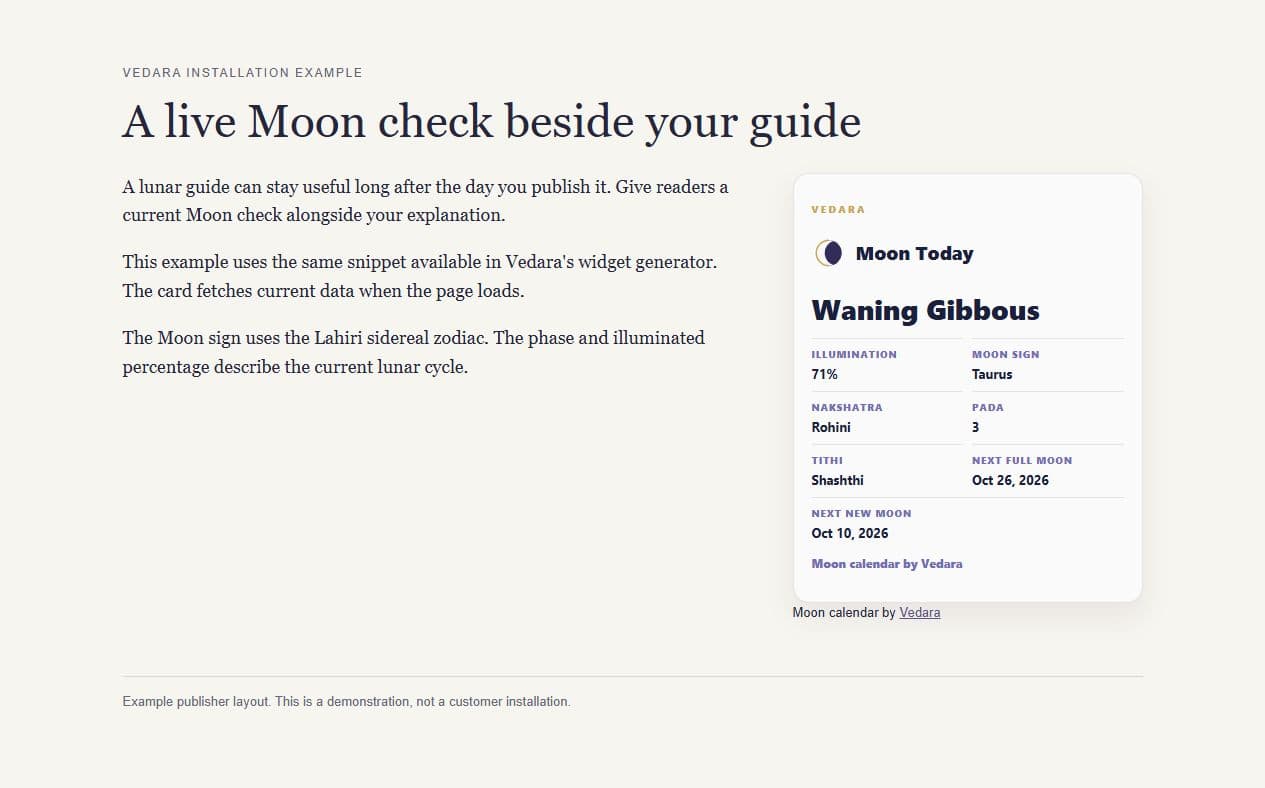
If you want a reusable way to see how that phase sits in the current lunar cycle, Vedara’s Moon Phase Calendar shows the Moon’s phase across days, so you can visually match your birth phase to points in each new cycle.
Step 6: Turn the phase into more than a fun fact
Finding your birth Moon phase is the mechanical part. The more interesting question is: What do I do with this?
In traditional astrology, the Moon phase at birth is often interpreted as a pattern in how you start, build, peak, and release things over time. That is an interpretation framework, not a proven scientific mechanism, but it can be useful as a self‑reflection lens.
A few practical next steps:
- Read a phase‑by‑phase interpretation that focuses on life patterns, not fixed personality labels. Vedara’s guide on Birth Moon Phase Meaning: A Practical Framework for How You Start, Build, and Release Things is built around that idea.
- If you want to go deeper into timing, look for a planning‑lens guide that walks through one simple experiment per phase, such as checking how you naturally handle the early, middle, and late stages of a project.
- Treat any soulmate or compatibility tools (for example, Moon Phase Soulmate Calculator: Do Your Phases Match? or Moon Phase Compatibility 🌗 Do Your Birth ...) as reflection prompts, not verdicts about a relationship.
The key test: does thinking about your birth Moon phase help you observe your real behaviour more clearly, or does it make you anxious or fatalistic? Keep the former, drop the latter.
Conclusion
You do not need to be an astronomer—or an astrologer—to get a trustworthy answer to “What Moon phase was I born under?”. You need decent inputs (date, location, ideally time), two or more calculators with slightly different designs, and a simple way to sanity‑check the output: are they broadly agreeing on waxing/waning, illumination, and phase family?
Once you have locked in a phase that passes that test, stop chasing precision and start using it. Treat it as one lens on how you tend to start and finish things, not as a rigid label or relationship verdict. When in doubt, go back to the observable data—your history and habits—rather than treating any calculator as destiny.
If you want to see how your birth Moon phase sits inside the rhythm of current cycles, open the Moon Phase Calendar and watch where that same phase shows up each month.
Clear answers
Frequently asked questions
Do I really need my exact birth time to know my Moon phase?
Not always. Many calculators only ask for your birth date and still give a broadly correct Moon phase, especially if you were born far from an exact New or Full Moon. Tools like the Birth Moon Phase Calculator — Discover Your Lunar Personality use date alone.
Birth time becomes more important if:
- You were born on a New, First Quarter, Full, or Last Quarter Moon.
- Different calculators are giving noticeably different phases.
In those cases, prioritise a calculator that lets you enter time and place, or one that at least explains its approximation method, like the local‑noon approach described in Find the moon phase when you were born.
Why does one calculator say Full Moon and another say Waxing Gibbous for my birthday?
There are three common reasons:
- The two tools use different thresholds for when a phase switches from Gibbous to Full.
- One is assuming a fixed time (e.g. midnight or noon) and the other uses your actual birth time, putting you just before or just after exact Full.
- Time‑zone handling differs, especially if you were born close to the Universal Time date boundary.
Look at the illumination percentage if it is shown. If both say something like 97–100% and agree that the Moon is waxing or waning, they are describing almost the same point in the cycle, even if the phase label differs.
Can I use my birth Moon phase for serious life or relationship decisions?
It is better to treat your birth Moon phase as a soft lens for reflection, not as a decision engine. Traditional astrology uses it to talk about cycles of growth and release, which can be interesting to track in your own life, but it is not evidence for what must happen.
For important decisions—health, money, safety, long‑term commitments—use concrete information, professional advice where relevant, and honest communication. If you explore moon‑phase‑based compatibility tools such as Moon Phase Compatibility 🌗 Do Your Birth ..., treat any score or label as a conversation starter, not a verdict.
How is this different from my Moon sign or rashi?
Your Moon sign (or rashi, in Vedic terms) describes where the Moon was in the zodiac at your birth. Your Moon phase describes where the Moon was in its cycle relative to the Sun—New, Crescent, Quarter, Gibbous, Full, and so on.
You can share a Moon sign with someone and have totally different Moon phases, or share a phase and have different signs. If you want to understand your Moon sign as well as your phase, Vedara’s guide to using a rashi calculator for an accurate Moon sign is a good next step.
Evidence used
Sources
- Moonphasesoulmate.com — Birth Moon Phase Calculator
moonphasesoulmate.com
Used to verify: example of a moon phase calculator that takes only birth date and returns a birth moon phase and image.
- Adaytokeep.com — Find the moon phase when you were born
adaytokeep.com
Used to verify: example of a calculator that uses birth date, location and time, notes use of local noon, and returns phase plus illumination percentage.
- Tarostarot.com — Moon Phase Compatibility
tarostarot.com
Used to verify: example of a calculator that computes each person’s birth moon phase and overlays them for compatibility-style interpretations.
- Astromapped.com — Moon Phase Soulmate Calculator
astromapped.com
Used to verify: example of a soulmate-style calculator that finds each person’s birth phase and compares them.
- Vimeo — Natal Moon Phase Tutorial
vimeo.com
Used to verify: example of a resource that combines moon sign and moon phase calculation and shows they can be presented together.