
Vedic Birth Chart Calculator
Your Vedic birth chart in seconds
From birth details to your Vedic birth chart
Enter a date, local time and birthplace. Vedara resolves the location and calculates the same sidereal chart every time from the same details.
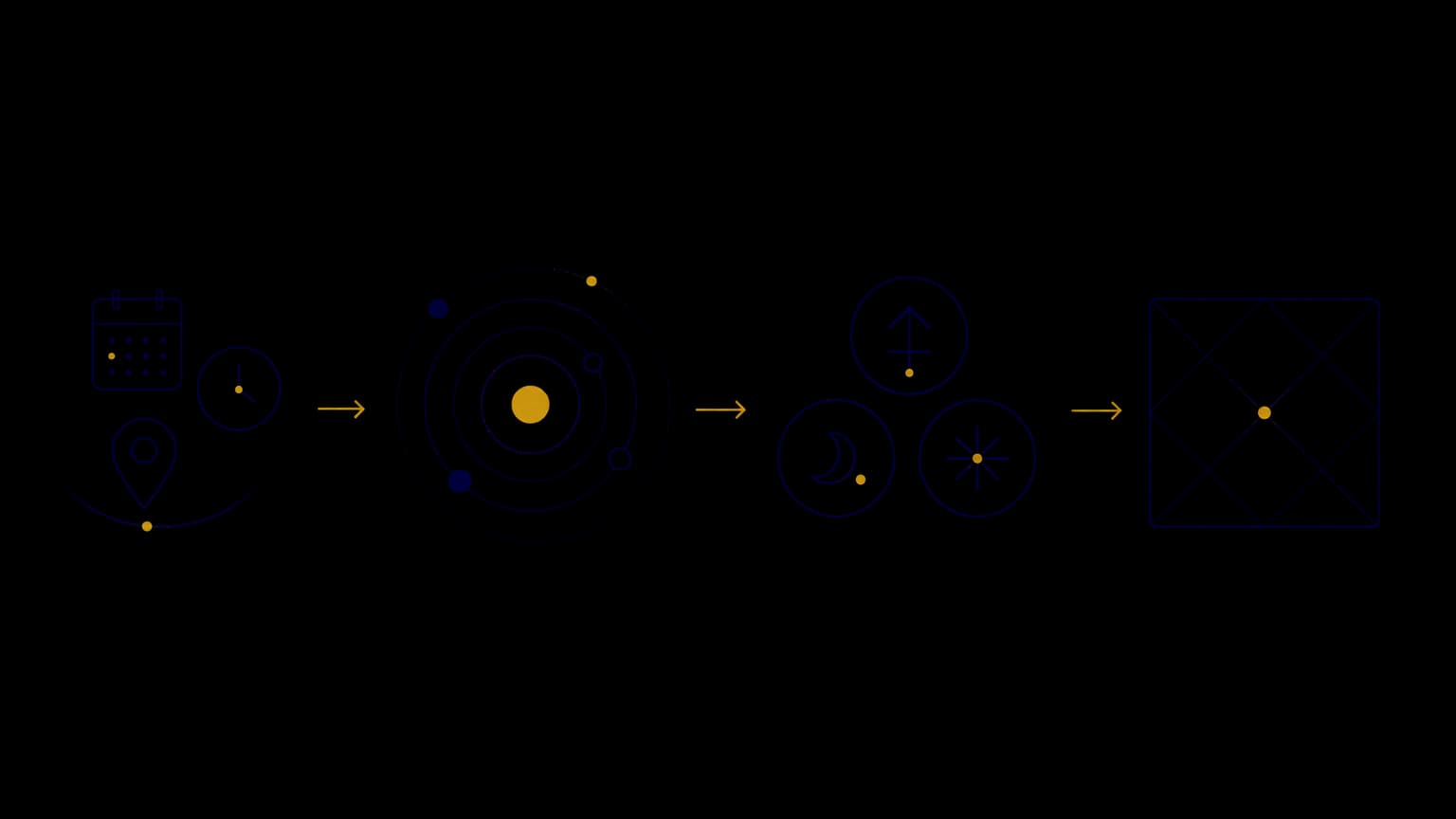
Birth date, time and place
The calculator resolves coordinates and local time.
Sidereal planetary positions
Lahiri ayanamsa fixes each planet in the sidereal zodiac.
Ascendant, Moon sign and nakshatra
These anchors come from the same planetary calculation.
Twelve houses
The Ascendant sets the house framework for the chart.
Worked example
Worked example: reading a Vedic birth chart
Fictional birth details: 1 January 1990, 12:00, London. The chart below is computed by the same engine as the calculator above, so you can see what each part of a result means before you enter your own details.
| Body | Sign | Degree | Nakshatra | House | Notes |
|---|---|---|---|---|---|
| Lagna | Aries | 1° 14' | Ashwini 1 | 1 | |
| Sun | Sagittarius | 17° 06' | Purva Ashadha 2 | 9 | |
| Moon | Aquarius | 9° 33' | Shatabhisha 1 | 11 | |
| Mars | Scorpio | 16° 17' | Anuradha 4 | 8 | Own sign |
| Mercury | Capricorn | 1° 58' | Uttara Ashadha 2 | 10 | Retrograde |
| Jupiter | Gemini | 11° 26' | Ardra 2 | 3 | Retrograde |
| Venus | Capricorn | 12° 31' | Shravana 1 | 10 | Retrograde |
| Saturn | Sagittarius | 21° 57' | Purva Ashadha 3 | 9 | |
| Rahu | Capricorn | 24° 43' | Dhanishta 1 | 10 | Retrograde |
| Ketu | Cancer | 24° 43' | Ashlesha 3 | 4 | Retrograde |
Navamsa (D9)
D9 lagna: Aries
- SunVirgo 3° 56'
- MoonSagittarius 25° 58'
- MarsScorpio 26° 36'
- MercuryCapricorn 17° 40'
- JupiterCapricorn 12° 51'
- VenusAries 22° 36'
- SaturnLibra 17° 31'
- RahuLeo 12° 28'
- KetuAquarius 12° 28'
Dasamsa (D10)
D10 lagna: Aries
- SunTaurus 21° 02'
- MoonTaurus 5° 31'
- MarsSagittarius 12° 53'
- MercuryVirgo 19° 37'
- JupiterVirgo 24° 16'
- VenusCapricorn 5° 07'
- SaturnCancer 9° 28'
- RahuTaurus 7° 11'
- KetuScorpio 7° 11'
Sidereal zodiac, Lahiri ayanamsha 23° 43', whole sign houses, PyEphem and Swiss Ephemeris, computed by vedara.me
Your Vedic birth chart, explained in plain English
A Vedic birth chart is a map of the sky at the moment you were born, read with the rules of Indian astrology (Jyotish). It uses the same planets and the same twelve sign names as a Western chart, but it measures them against the stars rather than the seasons, puts more weight on the Moon and the rising sign than on the Sun, and adds a timing system that tells you which planetary chapter of life you are in.
Enter your birth date, time, and place above and the calculator returns your Vedic birth chart (kundli): your ascendant (lagna, the rising sign), your Moon sign and birth nakshatra, and the position of all nine classical planets (Sun through Saturn, plus Rahu and Ketu) in sidereal signs and houses. This main chart is the rasi chart, also called D1 (rasi means sign). You can switch it between the North Indian diamond layout and the South Indian square layout, and below the planet table you can open the Navamsa (D9) and Dasamsa (D10) charts. The calculation runs on the same deterministic engine that powers the Vedara app: the same birth details always produce the same chart.
The chart uses the sidereal zodiac with the Lahiri ayanamsa, the standard reference frame of Vedic astrology. Sidereal positions track the visible constellations and currently sit about 24 degrees behind the tropical zodiac used by most Western websites, which is why your Vedic Sun or Moon sign is often one sign earlier than the one you grew up reading horoscopes for. Neither is a mistake; they are two different measuring systems.
Start reading the chart from the ascendant, which fixes the layout of your twelve houses and decides which areas of life each planet influences. Then look at the Moon: its sign and nakshatra describe your instinctive nature, and every Vedic timing calculation, including your Vimshottari dasha periods, grows out of that nakshatra. Someone born on 15 March 1992 at 14:30 in London, say, gets Cancer rising with the Moon also in Cancer, in the Ashlesha nakshatra. Mercury rules Ashlesha, so Mercury sets the starting dasha, and the Moon in its own sign gives the chart a strongly intuitive, feeling-led core.
Be careful with house readings if your birth time is rough. The ascendant changes sign about every two hours, so houses depend heavily on an accurate time; the planet-in-sign positions and usually the nakshatra hold up even when you only know the day. The chart is also just a snapshot. What it means for you this year comes from your current dasha and transits, which the Vedara app tracks daily.
Vedic and Western birth charts side by side
If you already know your Western chart, most of the Vedic one will look familiar. The differences below are what change the reading.
| Western chart | Vedic chart | |
|---|---|---|
| Zodiac | Tropical: Aries starts at the March equinox | Sidereal: Aries starts against the fixed stars, about 24 degrees earlier today |
| Sign people quote first | Sun sign | Moon sign and rising sign |
| Houses | Usually Placidus or another quadrant system | Whole sign houses: the rising sign is the whole 1st house, the next sign the 2nd, and so on |
| Planets | Sun to Pluto, including Uranus, Neptune and Pluto | Sun to Saturn plus Rahu and Ketu (the Moon’s nodes); outer planets are traditionally left out |
| Aspects | Angles measured in degrees with an orb | Whole-sign aspects: every planet looks at the 7th sign from it; Mars also the 4th and 8th, Jupiter the 5th and 9th, Saturn the 3rd and 10th |
| Moon detail | Sign and phase | Sign plus one of 27 nakshatras (lunar mansions) |
| Timing | Transits, progressions, solar returns | Dashas (planetary life chapters) plus transits |
How to choose a Vedic birth chart calculator
Most free calculators agree on the planet signs. They differ in settings you can’t always see, and those settings change the ascendant, the houses and the nakshatra. Check these before you trust a result.
To test any calculator, enter the same birth details in two tools that both use the Lahiri ayanamsa. The planet degrees should match within a few minutes of arc. If the ascendant differs, check the time zone first.
| What to check | Why it matters | This calculator |
|---|---|---|
| Zodiac and ayanamsa | The ayanamsa sets the gap between the sidereal and tropical zodiacs. A different value can move a planet near the edge of a sign into the next sign. | Sidereal zodiac with the Lahiri ayanamsa. The exact value is shown under the planet table. |
| Birthplace and time zone | An hour’s error moves the ascendant about 15 degrees, often into the next sign. | Finds the time zone of your birthplace and applies the daylight saving rule in force on your birth date. |
| House system | Vedic astrology uses whole sign houses. A calculator that uses Western house cusps can put planets in different houses. | Whole sign houses: the rising sign is the whole 1st house. |
| Chart style | North Indian and South Indian charts show the same positions in different layouts. | Both. Switch between them above the chart. |
| Nakshatra and pada | The Moon’s nakshatra starts your dasha sequence. The pada (quarter) narrows it down. | Nakshatra and pada for the ascendant and every planet. |
| Divisional charts | The Navamsa (D9) is read with the main chart, and the Dasamsa (D10) is used for career. | D9 and D10 charts with every planet’s sign and degree. |
| Unknown birth time | Without a time, the ascendant and houses are estimates. | Uses noon and marks the ascendant as approximate. |
| Method | If a calculator doesn’t say how it calculates, you can’t check it. | A line under the planet table names the zodiac, ayanamsa, house system and ephemeris. |
| Price and signup | Some sites ask for an email before they show the chart. | Free. The chart shows without an account. |
Clear answers
Frequently asked questions
Is this birth chart calculator really free?
Yes. Enter your birth details and the chart renders immediately, no signup required. An account is for what the chart cannot tell you on its own: your chart is fixed for life, while the sky moving against it changes daily, so a free account turns it into personalised daily timing.
Why is my Vedic sign different from my usual zodiac sign?
Vedic astrology uses the sidereal zodiac (aligned to the stars, Lahiri ayanamsa), while Western astrology uses the tropical zodiac (aligned to the seasons). The two are offset by roughly 24 degrees, so your Vedic Sun or Moon sign is often the preceding sign.
What if I don’t know my exact birth time?
Enter the date and place and leave the time blank. Planet-in-sign positions and usually your nakshatra remain valid, but your ascendant and house placements need a real birth time: the ascendant changes about every two hours.
What is a kundli and is this the same thing?
Yes. Kundli (or janma kundali) is simply the Sanskrit-derived name for the Vedic birth chart: the map of the sky at your moment of birth, drawn in the sidereal zodiac with the ascendant marking the first house.
Should I use a North Indian or a South Indian chart?
Use the one you find easier to read. Both show the same chart. The North Indian chart keeps the houses fixed: the top diamond is always the 1st house, and a number in each house shows its sign. The South Indian chart keeps the signs fixed: Pisces is always the top left box, and a gold line marks the ascendant’s sign. You can switch between them above the chart.
What is a rasi chart (D1)?
The rasi chart is the main Vedic birth chart. Rasi means sign, and D1 means the first divisional chart: the sky split into the twelve whole signs. Other divisional charts, such as the Navamsa (D9), split each sign into smaller parts and are read alongside it. When people say “my kundli”, they usually mean the rasi chart.
Related tools
- Vedic vs Western Sign Calculator: your Sun, Moon and rising in both zodiacs
- Navamsa Chart Calculator: your D9 chart, planet by planet
- Dasha Calculator: which Vimshottari period you are in right now
- Nakshatra Calculator: your birth star and its meaning
- How Vedic astrology timing works: dasha and muhurta explained