Moon phases and lunar timing
New Moon Dates 2026 UK: Turn the Lunar Calendar into a Planning Tool
New moon dates 2026 UK are easy to find. This guide shows how to turn them into a light planning system: get UK‑relevant dates, give each new moon a job, and use a 3–5 day window with a built‑in review.
Typing “new moon dates 2026 UK” gives you plenty of tables. The real question is what you are meant to do with those dates once you have them. This guide keeps things practical: how to get UK‑accurate new moon dates for 2026, how to use the next new moon as a planning window, and how to loop that across the year without turning it into a second job.
We stay close to astronomy for the dates. Astrology is treated as a traditional story about timing, not a force that decides your career, relationship, or money.
1. Get UK‑relevant new moon dates for 2026
First job: make sure the 2026 new moon dates you are using actually match your time zone.
What to do
- Pick the UK location you want to plan from (usually where you live or work).
- Use an astronomy‑based calendar or app that clearly shows time zone and location.
- Copy the 2026 new moon dates into your normal planning system (Google Calendar, paper diary, notes app).
Why this matters
“New moon” is one global event, but the clock time you see depends on time zone and how a site converts it. A European phase table for Waterford in Ireland, for example, lists a late‑2026 new moon on 10/10/2026, with earlier phases on different dates around it.Full Moon Waterford, Ireland — 2026 Moon Phases
That shows two things:
- You need a source that makes location and time zone obvious.
- You always need to check you are on the new moon row, not the nearest full moon.
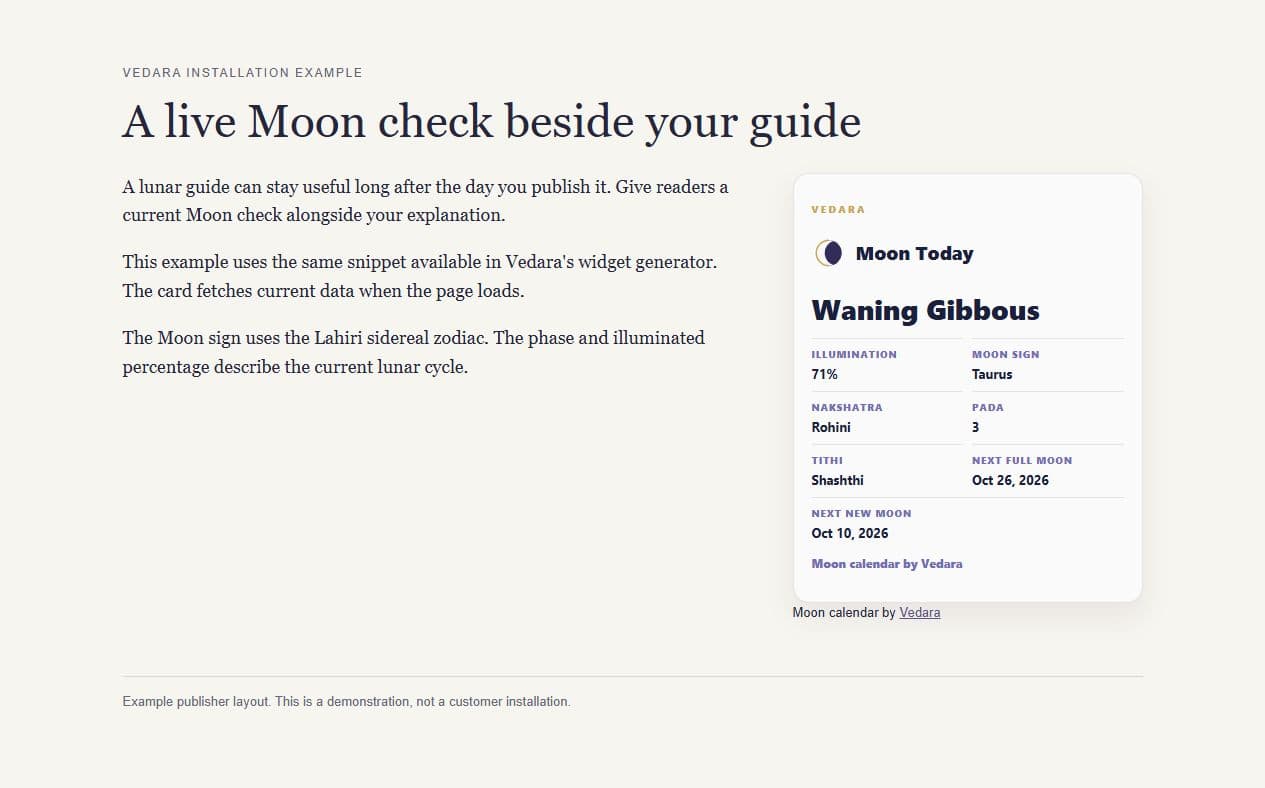
A live Moon Phase Calendar usually handles the conversion for you: you choose your date, it shows the current phase and when the next new moon in the UK falls.
Common pitfalls
- New moon vs crescent visibility. Some religious calendars are based on when the crescent can first be seen, which can be a day after the astronomical new moon. A UK moonsighting group, for instance, gives a precise astronomical new moon time in March 2026, then separately looks at when the crescent might be visible for Eid.Shawwal moonsighting and Eid date announcement — New Crescent Society
- Copy‑pasting US dates. An article written in US time can land on a different calendar day in the UK, especially if the phase is near midnight.
If you cannot confirm a date for your location, shrug and treat that lunation as a loose “early‑month reset” rather than a precise timing anchor.
Early‑2026 new moon snapshot (pattern only)
The evidence here covers specific phase timing near Ireland later in 2026, not a full UK‑wide ephemeris. So this is a pattern example, not official astronomical data:
- 21/01/2026 – new moon (example)
- 19/02/2026 – new moon (example)
- 20/03/2026 – new moon (example)
If your UK‑based tool shows similar late‑month dates, you can treat them as your first three reset points of the year. The exact day and time may differ. The method does not.
A simple way to label those three:
- January new moon → start slot.
- February new moon → adjust slot.
- March new moon → close slot.
Once you have tried that rhythm on real dates in your own diary, you can repeat it for the rest of 2026.
2. Give each 2026 new moon a clear job
A new moon only becomes useful when it has a job. Otherwise it is yet another date you vaguely mean to “use better”.
What to do
- Once you have all the 2026 UK new moon dates, sit down once and give each one a role.
- For every month, pick one role:
- Start something
- Adjust or simplify something
- Close or archive something
- Write that role next to the date in your calendar.
Without this, “new moon” turns into fuzzy pressure to do something important. With it, you get one simple instruction each month.
Astrologers often call the new moon the “seed” part of the month: behind‑the‑scenes work before anything is public. Think “draft the proposal” rather than “quit your job now”. Labelling each date ahead of time turns that symbolism into a single rule you can actually follow.
A basic year pattern you can steal and then tweak:
- January, May, September: Start months – small, testable initiatives.
- February, June, October: Adjust months – prune, edit, fix processes.
- March, July, November: Close months – archive stalled ideas.
- April, August, December: Free months – no planned lunar work; just notice what happens.
The exact sequence is flexible. The useful bit is sticking to some structure.
Where this usually goes wrong:
- Trying to make every new moon do everything: “start, adjust and close” in the same week.
- Waiting until the last minute to choose; by then, the week is already booked solid.
3. Choose one life area for your new moon work
Lunar timing works best when you give it one lane in your life, not all of them.
Pick a primary area for the whole of 2026, for example:
- Work and projects
- Money and logistics
- Home and admin
- Health habits (not medical treatment decisions)
- Learning and creativity
Then write yourself a straightforward rule, such as:
- Work focus: “At each new moon I start or adjust one small work experiment.”
- Money focus: “At each new moon I change one recurring expense or savings rule.”
Trying to use the new moon to overhaul your entire life every four weeks is a fast route to feeling stuck. One lane, tiny steps.
Traditional Jyotish might talk about different new moons lighting up different houses and signs in your chart. That can be interesting, but you do not need it to make this useful. At this point you are just borrowing the rhythm.
Two ways to pick your focus:
- History‑first: Which area kept slipping last year? Give that to the Moon.
- Goal‑first: If 2026 has one obvious priority (say, stabilising income), anchor the whole new moon sequence to it.
If you want more nuance later, you can layer on personal cycle pieces such as Birth Moon Phase Meaning: A Practical Framework for How You Start, Build, and Release Things or Born on a Specific Moon Phase? How to Turn Your Birthday Moon into a Practical Planning Lens (Not Just a Fun Fact). The underlying start–review loop stays the same.
Top ways people derail themselves here:
- Switching focus area every month because it feels more exciting.
- Using lunar timing to dodge obvious admin (“I’ll wait for the right phase” instead of sending the form).
4. Treat the next new moon as a 3–5 day window
Once you have your dates and your focus, simplify the timing.
When you see “next new moon UK”, mentally translate it into a short window where you move one concrete thing forward.
Practical rule
“For two days before and two days after the new moon date, I will prioritise one small, defined action in my chosen area.”
Examples:
- Work: Outline a new product, send three exploratory emails, or trial a new schedule for a week.
- Money: Cancel one underused subscription, move a direct debit date, or start a tiny monthly transfer into savings.
- Home: Pick one cupboard, drawer, or folder system and reset it.
The astronomical new moon itself is a precise instant. Daily life is not. A 3–5 day window means you still “catch” the lunation even if the exact moment lands while you are asleep or in a meeting.
Traditional Jyotish might tie that window to specific houses from your natal Moon, but as a basic planning tool, that is optional. Treat it like a monthly “soft launch” slot.
Common traps:
- Using the new moon as a deadline for big, risky moves.
- Giving up if you miss the exact date instead of using the rest of the window.
A one‑page monthly checklist you can reuse
Print or copy this and keep it with your 2026 new moon dates. Use one row per lunation.
- Date of new moon (UK): ……………………
- Role for this month (circle one): Start / Adjust / Close
- Life area (one only): Work / Money / Home / Health habits / Learning / Other: …………
- One small action for the 3–5 day window:
- I will: …………………………………………………………………………
- Earliest day I can start: …………… Latest day I am willing to act: ……………
- Tiny risk check:
- Is this medical, mental‑health, legal, safety‑related, or a major financial decision? Yes / No
- If Yes, stop and choose a different, low‑stakes action.
You can run an entire year of lunar planning off that single template.
5. Pair every 2026 new moon with a full moon review
The start is only half of the system. The review is where you learn what is actually working.
What to do
- For each 2026 new moon date, note the next full moon date as well.
- When that full moon window arrives, do a quick 10‑minute review of what you began or adjusted at the new moon.
- Ask yourself:
- Did I do the thing I said I would?
- What changed, if anything?
- Should I continue, tweak, or close this at the next new moon?
Without a repeatable review, you end up with a long list of starts and no feedback. Full moons are traditionally linked with visibility and culmination, which makes them neat check‑in points.
You do not need perfect full moon data to begin. A “roughly two weeks later” reminder still improves things. If you already keep a lunar calendar, pairing exact dates just tightens the loop.
You can deepen this timing later by adding personal phase tools like What Moon Phase Was I Born Under? How to Use Any Calculator (and Actually Trust the Result), but the basic start–review rhythm works on its own.
Keep reviews light:
- They are for observing patterns, not grading yourself.
- Three questions is plenty; a 20‑question template is a good way to avoid doing it at all.
Quick money example over two lunations
Say you choose money and logistics as your focus for 2026.
- Your tool shows a new moon on 21/04/2026 in UK time (example date). You have marked April as a start month.
- In that 3–5 day window, you cancel one streaming service you rarely use and set up an automatic £20 per month transfer into a savings pot called “Buffer 2026”.
- You note: “April new moon – cancelled X, started £20 buffer transfer.”
- At the following full moon, you spend 10 minutes checking:
- Did the cancellation go through?
- Did the £20 leave your account, and did you actually feel it?
- On a stress scale from 1–10, how did that change feel?
Next, your calendar shows a May new moon you have labelled adjust.
- In that window, you nudge your pension contribution up by 1%, or move the £20 transfer to just after payday.
- At the May full moon, you open your banking app and ask:
- Did I stick to the tweak?
- Do I keep it, roll it back, or increase it at the June new moon?
No forecasts. Just one small money action per lunation and one honest check‑in. Over a few cycles, the pattern becomes obvious.
6. Keep lunar timing away from high‑stakes decisions
This system is meant for low‑risk, reversible stuff. Anything big needs a different standard.
Before you let a 2026 new moon date affect a choice, run this filter:
- Is this medical, mental‑health, legal, safety‑related, or a major financial decision?
- If yes: do not time it by the Moon. Use evidence, professional advice, and practical constraints.
- If no: feel free to use new moons as a soft planning framework.
Safe things to time with new moons:
- When to start a side project.
- When to declutter an inbox or a room.
- When to run a personal work review.
Things that should not depend on lunar phases:
- Starting or stopping medication.
- Leaving a relationship because of serious conflict or abuse.
- High‑risk investments or major financial commitments.
Traditional astrology offers stories and symbols about cycles. It does not replace due diligence, consent, or expert help.
Conclusion
Knowing the new moon dates for 2026 in the UK is easy. Making them useful takes a little more:
- UK‑relevant dates from a tool that handles time zones clearly.
- One clear job for each new moon.
- One life area to focus on.
- A small 3–5 day action window and a built‑in full moon review.
Once you have that, “When is the next new moon in the UK?” stops being trivia and becomes a cue: time to start, adjust, or close one concrete thing that actually matters to you.
From here, the tidy next step is to plug real dates into this outline. Open the Moon Phase Calendar, grab the upcoming 2026 new moon dates for your location, label them, and quietly test this timing loop over a few lunations to see how it changes the way you plan.
Clear answers
Frequently asked questions
How do I quickly find the next new moon in the UK right now?
Use a moon phase tool or calendar that lets you enter today’s date and shows the current phase plus the next ones. Check that it either recognises your UK time zone or clearly tells you which time zone it uses. If it is US‑based and does not adjust, remember the listed time might land on the previous or next calendar day in the UK.
Do I need my birth chart or star sign to use 2026 new moon dates?
No. The method here does not rely on natal charts at all. You just need reasonably accurate 2026 new moon dates for your UK location, one life area to focus on, and a willingness to do one small thing per lunation and review it later. Traditional Vedic or Western meanings can be an extra layer if you enjoy them, but they are not required.
Is it worth starting big projects exactly on the new moon?
Not usually. It is more realistic to treat the new moon as the kick‑off window for early work: outlining, talking to people, scoping options. The actual launch date should be set around practical constraints, not forced onto an exact lunar moment.
What if a 2026 new moon falls in a chaotic week for me?
Shrink the plan instead of skipping it. Swap “start a new routine” for “write one page about what I want the next quarter to look like” or “cancel one tiny subscription”. The point is continuity, not perfection. If you miss the whole window, just rejoin at the next new moon without trying to make up for lost time.
How do astronomical new moon dates relate to religious lunar calendars in the UK?
Many religious calendars, especially Islamic ones, use crescent visibility, not the exact astronomical new moon. That can shift key dates by a day. If you follow a religious calendar, keep that for observance, and treat the astronomical new moon as a separate, optional planning tool so the two do not clash.
Evidence used
Sources
- Full Moon Phase — Full Moon Waterford, Ireland | 2026 Moon Phases
fullmoonphase.com
Used to illustrate: example 2026 Moon phase dates in a nearby European location, including a listed new moon on 10/10/2026 and surrounding September phases, to show why local, time‑zone‑aware data matters.
Used to illustrate: the distinction between astronomical new moon timing and later crescent visibility in March 2026 for UK‑based religious calendars.