
Birth charts and sidereal calculators
How to Use ChatGPT for a Vedic Birth Chart with Vedara
Connect Vedara to ChatGPT, ask for a calculated Vedic birth chart, and understand what the result can tell you. Includes starter prompts, a checked example and birth-time limits.
You can ask ChatGPT about a Vedic birth chart in ordinary language. The useful question is where the chart itself comes from. A fluent explanation is easier to trust when you can see which details were calculated and which are interpretation.
Vedara connects its astrology calculation tools to ChatGPT. This guide takes you from opening the listing to asking a first question, then checking what the answer actually contains.
Before you start
- The calculation tools are free and do not require a Vedara account. You need access to ChatGPT and the Vedara plugin in your ChatGPT interface.
- For a birth chart, have your birth date, recorded birth time and birthplace ready. Ask before sending those details to Vedara.
- If you prefer to begin without birth details, ask about today's sidereal sky instead.
This guide was checked on 1 October 2026. ChatGPT's labels and availability can vary by account and interface. The listing was checked in an account where Vedara was already installed; this was not a fresh-install test on every ChatGPT plan.
1. Open Vedara in ChatGPT
Start at Vedara for ChatGPT and select Open Vedara in ChatGPT. Check that the listing is named Vedara Vedic Astrology and the developer is Vedara.
If it is not installed, follow the listing's installation flow. Where offered, select Install plugin, then Use without an account to begin with the free calculation tools. If it is already installed, select Try in chat.
In a supported conversation, you can select an available app or plugin through the + menu or mention it with @. Some interfaces put additional options under More. See OpenAI's app guidance if your controls differ.
Make sure Vedara is selected before asking for a calculation. Typing its name in an ordinary chat is not evidence that a tool was called.
2. Ask for your birth chart, with permission
Copy this starter prompt:
Help me understand my Vedic birth chart (Kundli) with Vedara. Ask for my birth date, time and place, and ask before sending them to Vedara. Explain my Ascendant, Moon sign and nakshatra using the calculated chart.
Give the birthplace as a city and country, and say whether the time is the local time recorded at birth. If the city name is ambiguous, clarify it before the calculation. Check any details ChatGPT repeats back, especially the date format and time.
Read the permission prompt before allowing birth details to be shared. The request above expresses your preference; it does not replace ChatGPT's own permission controls or either service's privacy policy.
The starter prompts page offers English, Ukrainian, Russian, Hindi, French, German and Spanish. Choose the language you want to use in the conversation.
3. Separate the chart from its interpretation
A useful answer should make its calculated starting point clear. Begin with three details: the Ascendant, Moon sign and Moon nakshatra. Then ask what those terms mean in Jyotish.
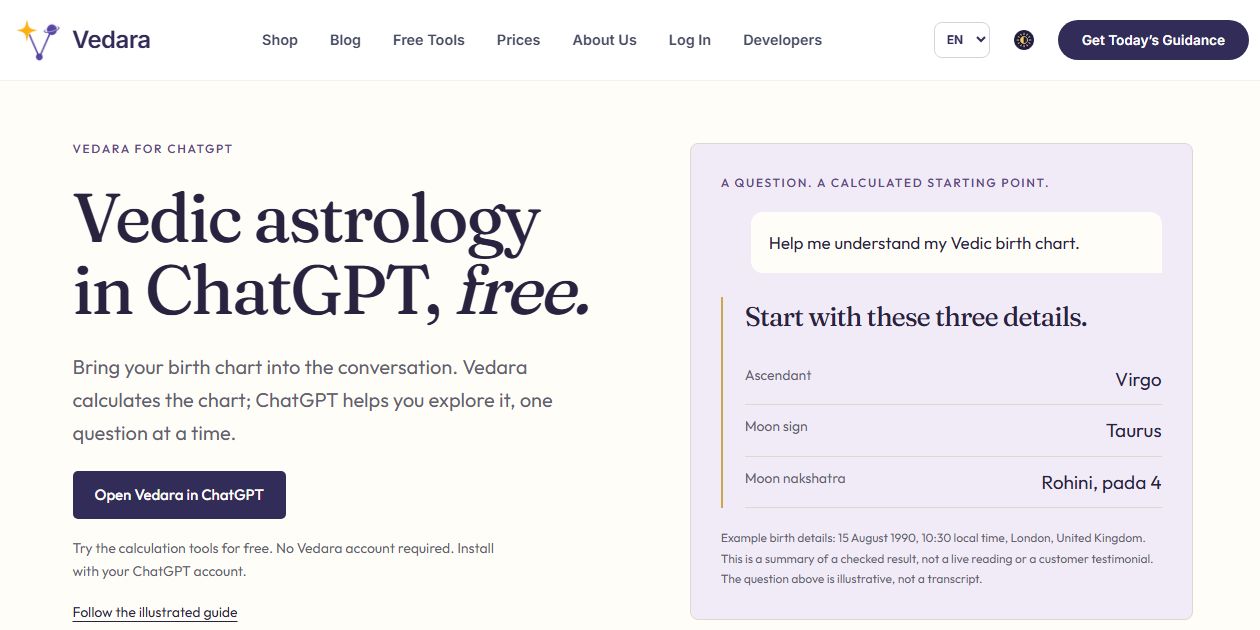
Vedara's introduction page, captured for this guide. The example panel is an editorial summary of a checked calculation, not a screenshot of a ChatGPT reply.
For a fictional example using 15 August 1990, 10:30 local time, London, United Kingdom, a checked Vedara calculation returned:
| Chart detail | Calculated result |
|---|---|
| Ascendant | Virgo |
| Moon sign | Taurus |
| Moon nakshatra | Rohini, pada 4 |
The published ChatGPT plugin's chart calculation was checked with these example details on 1 October 2026. This is one test case, not a claim that every possible chart or response has been tested.
The signs and nakshatra are outputs of the calculation. A sentence about what Virgo rising might mean for a person's habits is an astrological interpretation. The calculation does not establish someone's personality or future.
Try a follow-up such as:
Explain the difference between my Ascendant and Moon sign. Keep the calculated facts separate from the interpretation, and do not infer events that the chart data does not establish.
If the answer gives placements without showing a Vedara calculation, ask it to calculate the chart with Vedara first. Our case study on ChatGPT and chart interpretation explains why that distinction matters.
4. Handle an uncertain birth time honestly
Do not fill in noon simply to make the form complete. Without a birth time, the Ascendant and houses cannot be established reliably. Other details can also change during a day, so ask which results remain uncertain.
Use this follow-up:
I do not know my birth time. Explain what you can calculate from the details I have, what remains uncertain, and which questions need an accurate time. Do not invent an Ascendant or houses.
In the checked unknown-time follow-up, the system declined to invent an Ascendant or houses. That is the useful behaviour to look for when reviewing your own conversation.
5. Choose whether to connect a Vedara account
You can use the calculation tools without a Vedara account. Connecting an existing account is for saved-profile features, such as using your stored chart or asking for personalised daily timing without entering the birth details again. Those features require a completed birth profile.
Start without linking an account if you only want to try a calculation. To try the service without birth data at all, ask:
Use Vedara to show today's sidereal sky. Ask which timezone to use, then explain the planetary signs and nakshatras in plain language. Separate calculated facts from interpretation.
Review the Vedara privacy policy and ChatGPT's permission information before sharing personal details. Do not assume that a connected app receives no conversation context; what is shared depends on the request and the platform's controls.
Common questions
Is Vedara free in ChatGPT?
Vedara's calculation and saved-profile tools are free. Basic calculations do not require a Vedara account. ChatGPT access and plugin availability are governed separately by OpenAI, so this guide does not promise access on every plan or in every region.
Why is my Vedic sign different from another horoscope?
Vedara calculates a Lahiri sidereal chart. A horoscope using the tropical zodiac can give different sign placements. Ask which zodiac and calculation settings were used before treating the difference as an error.
Can I use it without knowing my birth time?
You can ask about the current sky without birth details. For a natal chart with an unknown time, ask explicitly about the limits. Do not treat a guessed Ascendant or house placement as your chart.
Should I treat the answer as a prediction?
Use it to explore an astrological framework and ask better questions. Keep interpretations proportionate to the available data and avoid treating them as guaranteed outcomes or a substitute for professional advice.
Your next question
One clear question is enough to begin. Open Vedara's ChatGPT guide and choose a starter prompt, then check the calculated facts before exploring their meaning.
Sources and checks
- Vedara for ChatGPT: tool scope, account choices, supported prompt languages and the labelled worked example.
- Vedara's published ChatGPT listing: public identity and the installed-account entry point, checked 1 October 2026.
- OpenAI: apps in ChatGPT: how to choose an available app in a conversation.